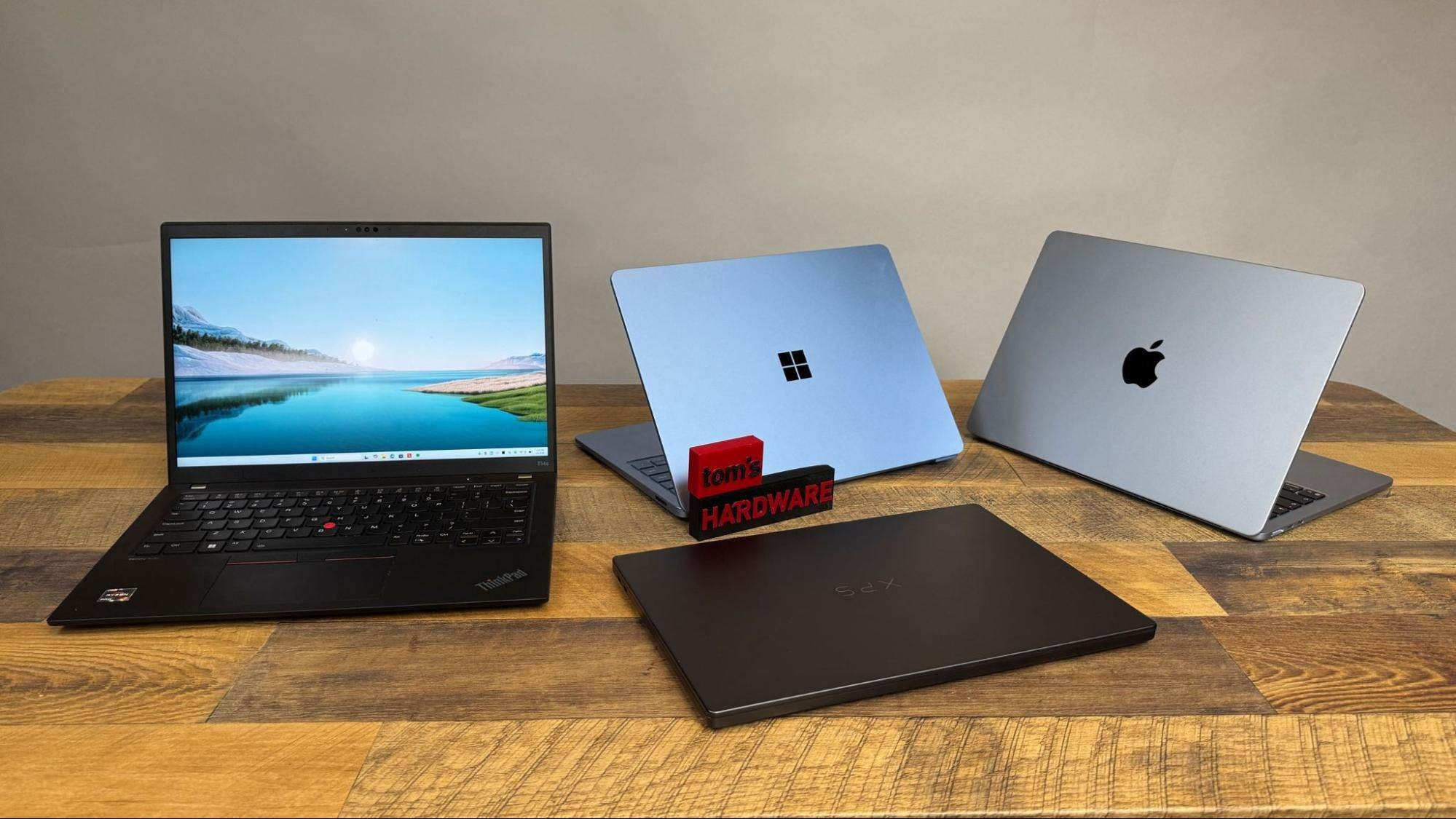
Editorial revision — November 12, 2026. The original GameLogNews article looked at laptop processors available or newly announced around April 2026: Intel Core Ultra Series 3, AMD Ryzen AI 400, Apple's M5 family and Qualcomm Snapdragon X2. These platforms have different strengths, but no manufacturer can be declared the best choice for every gaming or productivity laptop from marketing claims alone. The important buying criteria are actual laptop cooling, battery tests, integrated versus discrete graphics, game compatibility and cost.
Which laptop processor platforms mattered in early 2026?
| Ecosystem | Confirmed early-2026 laptop lineup | Important caveat |
|---|---|---|
| Intel x86 Windows | Core Ultra Series 3, code-named Panther Lake | GPU configuration and power limits vary by laptop |
| AMD x86 Windows | Ryzen AI 400, plus selected Ryzen AI Max+ systems | Different models have different integrated graphics |
| Apple macOS/Arm | M5, M5 Pro and M5 Max MacBooks | Windows-only games and software may not run natively |
| Qualcomm Windows on Arm | Snapdragon X2 Elite, X2 Elite Extreme and X2 Plus | Check Windows on Arm compatibility and graphics behavior |
The individual families and broad positioning come from first-party releases by Intel, AMD, Apple, and Qualcomm.
This is a historical comparison of the April 2026 landscape, not an automatically updated ranking that captures every processor launched after that month. Prices and exact models should be checked against current manufacturer and retailer listings.
Intel Core Ultra Series 3: what was actually new?
Intel announced Core Ultra Series 3 at CES on January 5, 2026, identifying it as its first client platform built on the Intel 18A manufacturing process. The company said the platform would support more than 200 laptop designs.
The top Core Ultra X9 and X7 variants were particularly important for thin-and-light gamers because they included larger integrated Intel Arc graphics, with models offering up to 12 Xe cores. Intel also advertised up to 50 TOPS from the NPU on some SKUs.
Those numbers are Intel's official specifications and promotional comparisons, not GameLogNews test results. The Intel launch announcement supplies the platform details.
A reader should not confuse Core Ultra Series 3 with the later Core Series 3 value-oriented brand launched in April. Intel's April 16 description presents the lower-cost range as related to Panther Lake technology, but it is not the identical SKU lineup.
AMD Ryzen AI 400: what can its AI hardware do?
AMD unveiled its Ryzen AI 400 and Ryzen AI PRO 400 mobile processors during CES 2026. The official January 5 AMD announcement lists up to 60 NPU TOPS for the new platform.
Some products use integrated Radeon graphics, while the Ryzen AI Max+ family targets higher graphics and memory performance in select thin systems or compact workstations. These should not all be treated as the same laptop GPU: model-level specifications matter.
AMD described advances in AI-assisted tasks, productivity and graphics. But NPU TOPS represent the chip's theoretical neural-compute capability under specified conditions. They are not an FPS rating for games and cannot by themselves predict how fast a graphics-heavy title will run.
Likewise, terms such as Gorgon Point are internal or platform code names. Shopping by product label, actual GPU configuration, cooling and independent battery measurements is more reliable than choosing by code name alone.
Apple M5, M5 Pro and M5 Max: strengths and limitations
Apple introduced the MacBook Air with M5 on March 3, 2026, describing a focus on efficiency, a new GPU design, and upgraded base storage. See Apple's dated product announcement.
Apple's 2026 16-inch MacBook Pro technical specifications also document M5 Pro and M5 Max systems, with different CPU/GPU core counts and unified-memory options. For example, the M5 Pro/Max specifications describe up to 18 CPU cores and multiple graphics configurations.
Apple's unified-memory architecture may help some creative and development workloads. However, an Apple GPU-core number cannot be compared directly with an Intel, AMD or Nvidia GPU-core count: these are different architectures and software ecosystems.
For gaming, macOS compatibility is often the most important constraint. A game built only for Windows may require translation, streaming or a separate machine, and some anti-cheat systems do not support the needed translation route.
Someone who mainly needs coding, media creation or battery life can value a MacBook highly, but the buyer still needs tests of their exact applications rather than assuming every game behaves the same across operating systems.
Qualcomm Snapdragon X2: is Windows on Arm ready for gaming?
Qualcomm's second-generation laptop offerings included Snapdragon X2 Elite Extreme, X2 Elite and X2 Plus, each targeting different notebook price and performance classes. The official Snapdragon laptop lineup describes the product families.
These chips use Arm-based CPU architecture and support Windows on Arm. They can run many native Arm64 applications and some x86 software through compatibility layers, but support varies by program, device driver and game.
A specific game may fail because of anti-cheat requirements, middleware, graphics API behavior or an unsupported driver. The CPU being fast in a productivity benchmark does not mean every DirectX game works correctly.
Qualcomm's published comparisons to Apple or Intel are vendor performance claims that may have narrow test conditions. GameLogNews has not verified those claims across a matched set of retail laptops.
For a prospective owner, check compatibility for the exact Steam library, launcher, VPN, printer, workplace tools and virtual machines that matter before buying a Windows-on-Arm notebook.
Which option is best for PC gaming?
There is no universal answer based on CPU brand alone. Many demanding games are limited by graphics hardware, so a laptop with a stronger discrete GPU can outperform a more expensive model with a faster CPU but weaker integrated graphics.
Within thin-and-light systems, an efficient integrated GPU may still provide good performance in lighter games or at reduced settings. But the result depends on memory bandwidth, power limits and cooling. A 240 Hz screen does not ensure that a game reaches 240 frames per second.
For users who want maximum compatibility with existing PC game libraries, an x86 Windows laptop is still a straightforward default. Intel and AMD both offer those processors, while gaming-focused notebooks from multiple manufacturers can pair them with Nvidia or AMD discrete graphics.
Even among x86 gaming laptops, the nominal processor designation is only part of the picture. Screen resolution, thermal design, fan behavior, system memory and wattage often change observed results significantly.
How should battery life be compared?
Battery capacity, display brightness, refresh rate, background processes, wireless networking, power plan and hardware configuration all influence runtime.
Manufacturer claims such as “up to 27 hours” are generally produced under specific light-use conditions, not during a demanding modern videogame. Comparing maximum marketing figures from different vendors without identical test settings is misleading.
A buyer should seek independent tests on the exact laptop model involving video playback, browsing or realistic office work. Gaming on battery usually draws far more power and may impose performance restrictions.
The same applies to thermals: a processor able to achieve a high boost clock in a short burst may perform differently during a sustained render or multi-hour gaming session.
Do NPU TOPS make a laptop faster for all AI tools?
No. A neural processing unit (NPU) accelerates specific local AI workloads designed to use its hardware and supported software stack. The quoted TOPS value does not equal overall CPU speed or a guaranteed acceleration factor for every chatbot, diffusion model or large language model.
Some tools use the GPU instead, and large local models can be constrained by RAM or GPU memory. The usefulness of an NPU depends on whether the application supports it and what data sizes it processes.
Intel, AMD, Apple and Qualcomm all highlight AI capabilities, but their accelerator frameworks and development environments differ. Check the requirements of the actual software, not just the marketing label “AI PC.”
For creators, local model workloads can be especially sensitive to GPU architecture, numerical precision, memory bandwidth and operating-system support.
What should buyers verify before purchasing?
Compare laptops with matching real workloads, not synthetic peak figures pulled from different marketing presentations. In particular, verify game and driver compatibility, actual integrated/discrete GPU, sustained CPU behavior, battery tests, RAM upgrade limitations and warranty/repair options.
Product names can look similar while hiding major differences in performance and configuration. Two “Core Ultra Series 3” notebooks may use different graphics blocks; two “Ryzen AI 400” systems may have radically different cooling and battery capacity.
A practical test or reputable independent review of the exact retail model is more informative than a one-line ranking of processor brands.
Quick answers
Which early-2026 chip families matter? Intel Core Ultra Series 3, AMD Ryzen AI 400, Apple M5-family MacBooks and Qualcomm Snapdragon X2.
Is a higher NPU TOPS number automatically better for games? No. FPS depends mainly on game compatibility, graphics performance and the system configuration.
Can a Snapdragon X2 laptop run every Windows game? No such guarantee exists; check individual game and anti-cheat support.
Is Apple M5 always the best for battery life? No. Compare independent tests of the exact laptop and workload.
Should I prioritize CPU or GPU for modern gaming? Often GPU capability and power limits matter more once the CPU is adequate, but this depends on the game.
Bottom line: The 2026 laptop market offered several powerful processor architectures, but buyers should choose the complete laptop and compatible software ecosystem, not a marketing-only cross-brand speed ranking.
Primary sources: Intel Core Ultra Series 3 launch; AMD Ryzen AI 400 CES launch; Apple MacBook Air M5 announcement; Apple M5 Pro/Max technical specifications; Qualcomm Snapdragon X series overview.
Source date: April 11, 2026