Editorial correction — November 11, 2026: This article originally described game-key cards as mandatory for Nintendo Switch 2 games and implied they required an internet connection every time a title launched. Nintendo's own documentation says neither claim is correct. The feature is now established, and this guide explains exactly how it works, how it differs from a normal game card and what happens when you lend or resell it. The original May 26 publication date remains unchanged.
What is a Nintendo Switch 2 game-key card?
A game-key card is a physical Nintendo Switch 2 card that holds the entitlement needed to download and then launch a specific game, rather than storing the complete software on the card itself. It must remain inserted when you play.
Nintendo distinguishes regular game cards, which carry the game data, from game-key cards, which act as the key for downloaded software. Both physical formats can be used on Nintendo Switch 2. Not every Switch 2 boxed game uses a game-key card.
Nintendo's official support instructions explain the three main steps: insert the card, download the game, and play with the card inserted. The official US FAQ confirms that the card can be used on another console as long as that system also downloads the software.
The system resembles a physical access key, not a cloud-streamed game. After the initial download, the game's data is stored locally, and the console can start it without a new internet connection in ordinary circumstances.
Do you need to be online every time you play?
No. Nintendo explicitly says an internet connection is required when launching a game-key card for the first time on a particular Switch 2, so that the game data can be downloaded. Once downloaded, the game can be launched offline, as long as the card is inserted.
This corrects a common misconception. A game-key card is not a permanent online-only streaming license. The initial download can be large, and certain multiplayer features, updates or software-specific checks may independently require internet access, but those are separate issues.
The original GameLogNews article suggested that connectivity was mandatory whenever a game-key card was used. That contradicts Nintendo's documentation and should not be repeated.
Nintendo also lists a minimum system software version for the format. Check the current support page for the system update requirement rather than relying on an old cached guide.
What storage space is needed?
Because the complete game is downloaded to the system, the user needs adequate space on the Switch 2's built-in storage or a compatible microSD Express card. The required amount is specified on game-key-card packaging and in the associated digital product information.
A regular game card can often reduce the initial download requirement because much of the game is stored on the card itself, though patches and DLC may still take additional storage. A game-key card cannot provide the complete software from the physical card alone.
This is the central trade-off for consumers who prefer physical editions. A boxed product can contain a card and printed artwork while still depending on a potentially substantial download.
A purchaser who has slow internet or limited data should check the required download size before buying. A buyer with limited storage should also check available capacity on the console.
Can you lend or resell the card?
Yes. Nintendo states that game-key cards are not tied to a particular Nintendo Account. You can lend or transfer the physical card; another Switch 2 system can download the required data and play with the card inserted.
Nintendo's October 2026 explanation of the format explicitly distinguishes the lending mechanism from the separate Virtual Game Card system used for certain digital purchases.
The physical card still matters: if you lend the card to someone else, you cannot launch the installed software from your own console using that card until you get it back. The game data remaining on your storage is not a standalone license.
Resale availability and consumer rights may differ depending on the region and retailer. The technical ability to move the physical card does not establish that every shop must accept a used game.
Do you need a Nintendo Account?
No Nintendo Account is required simply to download the game data from a game-key card, according to Nintendo's official support FAQ. The first download does require internet connectivity.
This is distinct from digital eShop purchases, Nintendo Switch Online membership, cloud saves and online multiplayer services, which may have their own account and subscription requirements.
If a game itself offers account-based features or online play, those features can still require an account. The important point is that Nintendo does not make a Nintendo Account a universal prerequisite for the physical key-card download procedure.
The game-key card therefore remains a physical possession that is transferable between compatible Switch 2 systems, rather than a single-use digital redemption code.
What happens if you lose the card?
The game data may remain installed on your Switch 2, but you cannot start the game without inserting the game-key card. Nintendo's official FAQ makes this requirement explicit.
That is similar to a normal cartridge in one respect: losing the physical item means losing the ability to play that particular physical copy. Unlike a normal full-data cartridge, however, the game also depends on a separate software download having been completed on that console.
A replacement physical card would be another copy of the game or another valid entitlement. Nintendo does not promise that a missing physical game-key card can be restored just by logging into your account.
Save data is a different matter. Nintendo says the game's save files are stored in the system memory, not on the game-key card. Some games may support backup or transfer features, subject to separate requirements.
How do you identify a game-key card in a store?
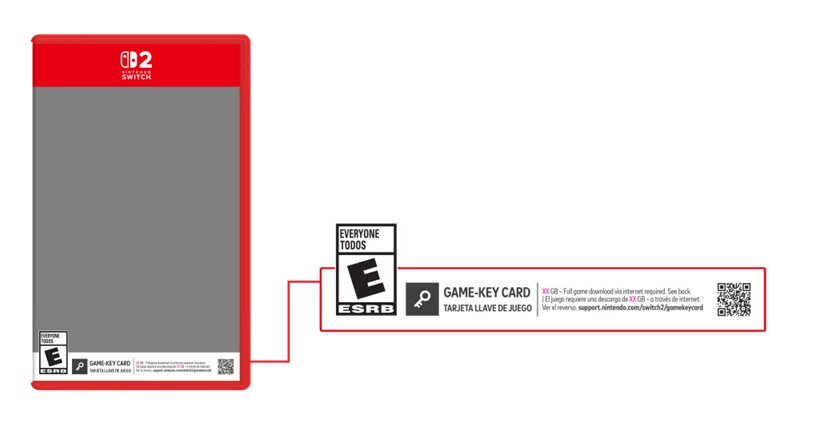
Nintendo says game-key-card packaging displays a distinctive label near the bottom of the cover, and the card itself has a key symbol at the top right. The box also indicates how much space is required to download the game.
If you are buying a used boxed game, examine the actual packaging and confirm the card is included. A listing that only shows a generic cover photograph may not make the difference obvious.
The existence of a physical box is not proof that the full software is on the card. Likewise, a game being sold for Switch 2 does not automatically mean it uses the key-card format, as standard physical game cards are also supported.
The Nintendo UK reference page includes annotated images of packaging and the key symbol.
Is it the same as a Virtual Game Card?
No. A Virtual Game Card is Nintendo's way to manage certain digitally purchased games and lend eligible digital content between family-group members under defined conditions. A game-key card is a physical object that can be inserted and handed to another person.
They share an analogy to lending a cartridge, but their account-management and download requirements are not the same. Confusing them leads to misleading advice about family sharing, permanent account binding and subscriptions.
The original article also speculated that Nintendo was forcing every physical Switch 2 release to use the new format as a deliberate licensing lock-in. The official documentation says publishers and games can use either regular cards or key cards. Nintendo's broader publishing choices should be discussed with evidence, not treated as a mandatory universal rule.
What are the preservation and ownership concerns?
Criticism of game-key cards has a real practical basis: the initial software download is essential. If a future service or region no longer provides the game data, an unused card without a local installation could be harder to use than a conventional cartridge containing a playable version.
That is a reasonable long-term concern, not a confirmed Nintendo plan to shut down downloads or disable every game-key card. None of Nintendo's cited instructions announces a shutdown date.
Conversely, the card can be transferred and resold, which is a meaningful distinction from an account-bound digital-only purchase. The most balanced explanation recognizes both properties instead of saying the system is either fully physical or fully digital.
Consumers can decide based on their priorities: physical collection, offline accessibility after setup, local storage needs, resale, and the game's exact edition. No single format is automatically best for every player.
Frequently asked questions
Does every Nintendo Switch 2 game require a game-key card?
No. Nintendo supports normal game cards and game-key cards.
Can you play offline after installing the game?
Yes, provided the required data is already downloaded and the physical game-key card is inserted; game-specific online features are separate.
Can I lend my key card?
Yes. Another Switch 2 can download the game and play with the borrowed physical card. It is not tied to your Nintendo Account.
Is the game stored on the card?
No. The key card contains the key, not the full game data.
Can I remove the card once it is downloaded?
No. The card must be inserted each time the game is played.
Are save files stored on the card?
No. Nintendo states that save data is kept in the console's system memory.
Official sources and image note
All procedural claims are supported by Nintendo of America's Game-Key Card Overview, the Nintendo UK game-key card guide, and Nintendo's October 2026 explanation.
The existing Nintendo Switch 2 key-card illustration is retained because it depicts the specific product format. It is currently third-party-hosted, however, and its copyright/provenance remains subject to a separate media-rights review. No fresh image or video has been copied without a verified license.
Source date: May 25, 2026