Editorial correction — November 11, 2026: The original April 13 report claimed Acer had just entered the PC power-supply market and began manufacturing a proprietary PSU for its Predator MI900 case. In fact, the Predator GX850 was already announced in September 2024; the April 2026 news was a detailed independent laboratory review. This corrected report focuses on the actual measured strengths and compromises, attributes every test result to the reviewer and preserves the original April 13 publication date.
When did Acer launch its Predator GX850 power supply?
Acer announced the Predator GX850 as an 850-watt SFX power supply in September 2024, rather than in April 2026. The contemporaneous September 9, 2024 launch report documents the product's introduction.
The April 13, 2026 Tom's Hardware review was noteworthy because reviewer E. Fylladitakis examined the GX850's internal components, voltage behavior, efficiency, noise and cooling under controlled conditions.
It did not represent a new first-day product launch or a sudden shift in Acer's business strategy. The old GameLogNews headline "why this changes everything" exaggerated an established part's market significance and failed to distinguish product announcement from later testing.
This article is an independent analysis of someone else's measurements, not a GameLogNews hands-on hardware review.
What are the main specifications?
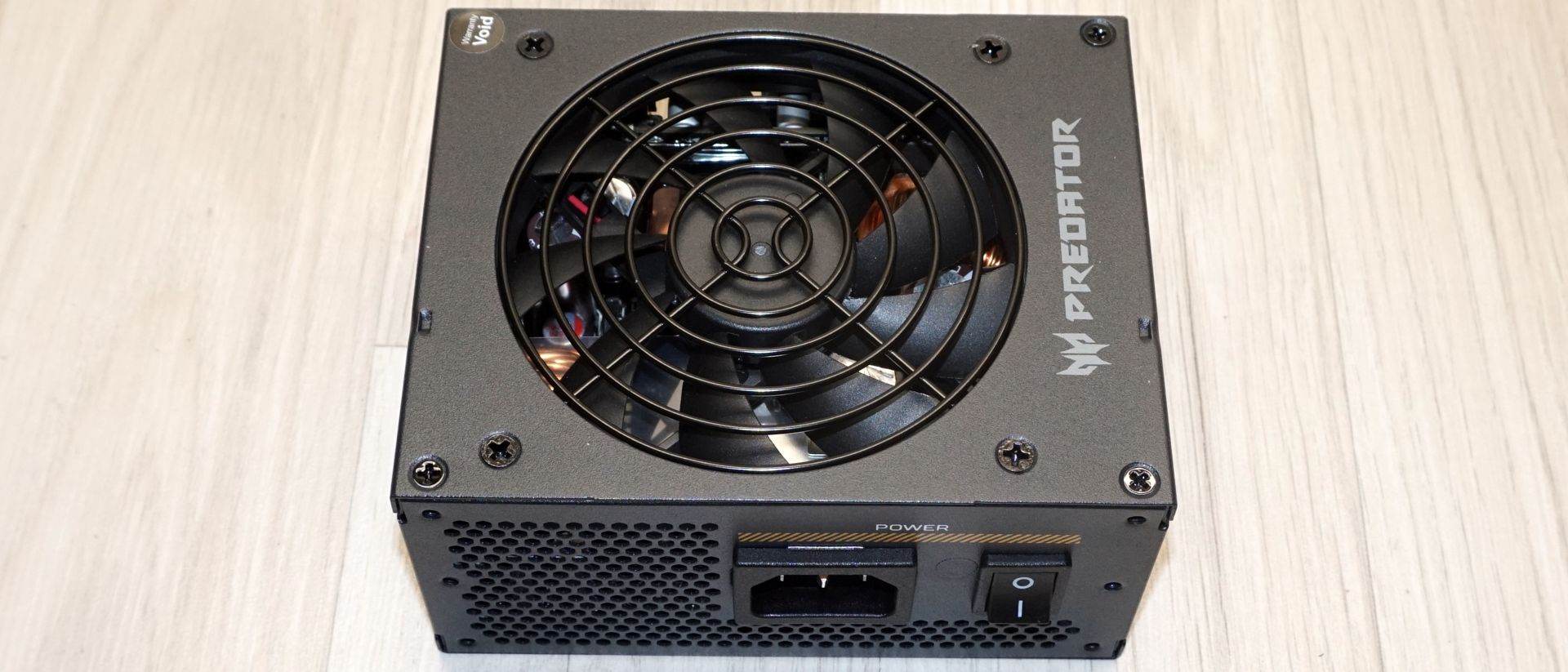
The GX850 is an 850-watt, fully modular SFX power supply. Its chassis is approximately 100 millimeters long, meeting standard SFX sizing, and the review describes ATX 3.0 compatibility.
| Feature | Reviewed GX850 specification |
|---|---|
| Rated total output | 850W |
| Form factor | SFX, 100mm chassis length |
| OEM platform | FSP Group |
| Cooling fan | 92mm |
| Main modular cables | 24-pin motherboard, EPS, PCIe and peripheral power |
| +12V rail | Up to 70.83A, according to its label |
| Historical review MSRP | US $150, not a verified current offer |
The GX850 was developed to complement Acer's Predator MI900 case but is not limited to that proprietary case. It uses standard SFX dimensions and can fit other compatible chassis, subject to cable and space requirements.
The earlier article wrongly suggested that Acer independently designed and manufactured every component. Tom's Hardware identified FSP as the original equipment manufacturer, with an established compact-PSU platform used as the basis.
Acer sells and brands the supply, while FSP's power-supply expertise is part of the engineering behind it.
How efficient was it in independent testing?
Tom's Hardware tested the unit using specialized electronic loads and meters, publishing separate results for room-temperature and heated conditions.
At about 25°C ambient temperature, the reviewer measured average nominal load efficiency of 90.1% at 115V AC and 91.6% at 230V AC.
Under a hotter environment, around 45°C ambient, those figures declined to 88.2% at 115V AC and 89.6% at 230V AC.
These results are strong for a compact Gold-class supply, but they are not perfect. A power supply naturally converts some electrical energy to heat, and efficiency changes with load, voltage and ambient temperature.
It would also be misleading to call the published figures an independent GameLogNews verification of a certification label. We are reporting the measurements and conclusions of Tom's Hardware, not running an electrical test bench ourselves.
What did the voltage and ripple testing show?
The reviewer reported solid voltage regulation: about 1.0% on the +12V rail, 1.2% on +5V and 1.1% on +3.3V across the tested load range.
Maximum measured ripple was 40 millivolts on +12V, 28mV on +5V and 26mV on +3.3V. Those values were within the relevant ATX limits in the review.
Ripple and voltage regulation are part of how a PSU supplies clean electricity to a gaming PC. Lower ripple is generally desirable, but comparing one model solely by its best numerical result can be misleading without considering other factors.
Tom's Hardware also tested important electrical protections, reporting appropriate responses to overcurrent and overpower conditions. That supports a positive assessment for the specific sample tested, not a guarantee that every unit will survive any malfunction.
No reviewer can promise lifetime reliability based on a single laboratory session.
Is the GX850 quiet?
Not at higher loads. Noise was the main practical drawback noted in the April 2026 testing.
The reviewer found the fan remained off at light loads, roughly until the power draw passed 220W. That can keep the PSU silent during light desktop use.
Fan speed then increased in noticeable steps. The first transition became audible around 450–500W, with another conspicuous increase near 700W. The test reported louder operation in hot conditions.
This is relevant to gaming builds using a powerful graphics card, because those components can push a compact PSU beyond its quiet fanless range. The exact noise heard by a player also depends on the case, distance, airflow and load.
A high-performance compact PSU can therefore be electrically competent while still being undesirable for someone who wants a particularly quiet PC.
Does it fit a normal ATX case?
The GX850 uses a standard SFX chassis, and Acer supplied an SFX-to-ATX mounting plate in the review kit. This can make it physically compatible with larger ATX cases.
However, Tom's Hardware noted that its included cables are short, which suits small enclosures but can become an issue in a large case with long cable-routing distances.
Buyers should check their exact chassis mounting position and connector lengths. An included adapter does not guarantee that the supplied EPS or GPU cables reach every location without a suitable extension or a different certified modular cable.
It is especially important not to mix modular PSU cables from unrelated models just because the connectors appear to fit. Pinouts can differ and incorrect cables can damage components.
The original article suggested the unit was part of a closed Acer-only ecosystem. The actual standard form factor and mounting adapter do not support that claim.
What about graphics card power connections?
The reviewer listed a modern PCIe 5.0 / 12VHPWR-style cable, alongside conventional PCIe connectors and motherboard/CPU connectors. The unit was designed for contemporary gaming GPUs requiring substantial power.
This does not mean every graphics card with a similar connector is guaranteed to work under all conditions, or that a nominal 850W unit is appropriate for every possible high-end CPU/GPU combination.
A sound PSU choice depends on the whole system's power needs and the graphics card manufacturer's current recommendations.
The review's power measurements were obtained with test instruments; they are not a benchmark of a specific Nvidia or AMD graphics card inside a complete gaming PC.
Was the component quality good?
Tom's Hardware found an FSP-built platform with components from established suppliers including Nippon Chemi-Con, Rubycon, Vishay, Infineon and Toshiba.
The source noted that most electrolytic capacitors were Japanese-made, while APAQ polymer capacitors were also present. Describing the unit as using exclusively Japanese capacitors would therefore be inaccurate.
Internal component quality, protection behavior and good test results support the reviewer’s broadly favorable assessment, with the important caveat that user-facing noise and pricing were less compelling.
For most buyers, this balance of strengths and compromises is more informative than a marketing claim that a new brand has changed the power-supply industry overnight.
Should you buy the Predator GX850 today?
It can make sense for an SFX-compatible, space-constrained 850W build, especially where cable management and compact size matter. The standard form factor, solid tested electrical results and modular connections are positive aspects.
However, compare it with current 850W SFX alternatives before making a purchase. The April 2026 review cited a historical MSRP of about $150, which is not a verified November price.
If quiet operation under sustained heavy load is your priority, the stepped cooling profile is a reason to investigate alternatives with gentler acoustic behavior. Also confirm fit, cable length, warranty and actual availability in your region.
This is a sourced product explanation, not a sponsored recommendation or affiliate shopping link.
Frequently asked questions
Is the Acer Predator GX850 a new product from April 2026?
No. It was announced in September 2024 and independently tested in April 2026.
Did Acer manufacture the PSU itself?
The tested unit used an FSP Group OEM platform sold under Acer's Predator branding.
Is it a standard SFX power supply?
Yes. The enclosure is approximately 100mm long, compatible with standard SFX mounts.
Does the fan turn off at low loads?
The reviewer measured fan-off behavior below approximately 220W in the test conditions.
Is it quiet during heavy gaming?
Noise increased noticeably around 450–500W and again around 700W in independent testing.
How efficient was it?
Tom's Hardware measured 90.1% (115V) and 91.6% (230V) average efficiency in its cooler test environment.
Original sources and image disclosure
Primary independent lab evidence: E. Fylladitakis, Tom's Hardware, April 13, 2026 — Predator GX850 SFX electrical review. Historical announcement date: Tom's Hardware, September 9, 2024. Numerical measurements, instrument work and opinions belong to the original reviewers and have been independently summarized rather than presented as our own testing.
The pre-existing hero depicts the actual Acer Predator GX850 but is hosted by Tom's Hardware. Its third-party image reuse permission remains unverified; it was not altered or re-uploaded during this factual rewrite.
Source date: April 13, 2026